
Stereoview editado nos EUA no final do séc. 19 por G. H. Drew

Vista da baía da Praia Grande

Imagem muito semelhante a esta da mesma época


Localizado no nº 29 da Rua da Felicidade, o estúdio de fotografia Liu Teh Fu foi dos mais conceituados em Macau nas décadas de 1940 a 1960.


 |
| Em 1908, tenente-coronel, enquanto Governador de Macau |
 |
| Auto de Posse do Governador in Boletim do Governo 22.8.1908 |


Guia turístico de pequenas dimensões e 40 páginas incluindo um mapa desdobrável.


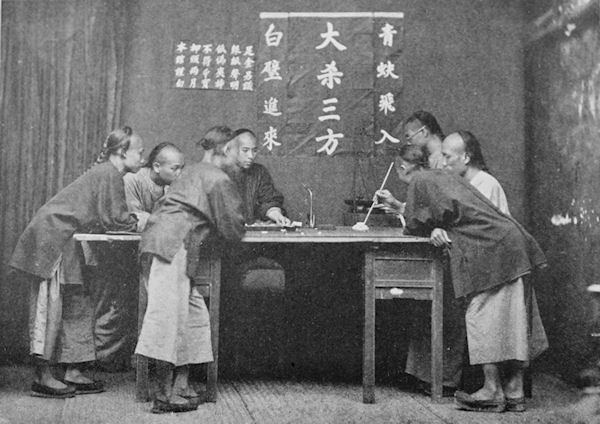 |
| A Fantan gambling house in Macao |
 "Wanderings East of Suez in Ceylon, India, China and Japan" é o título do livro da autoria de Frederic Courtland Penfield. Foi publicado (349 pp) pela primeira vez em Nova Iorque no ano de 1907.
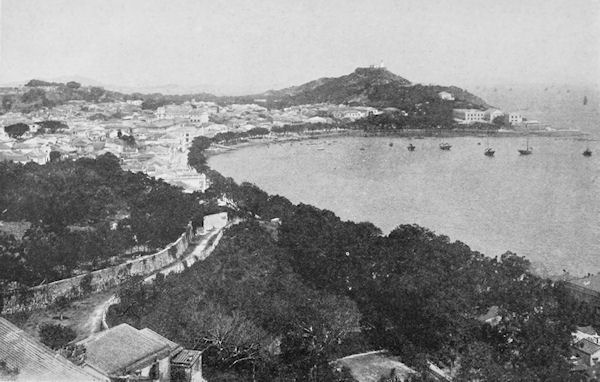 | ||
Principal section of Macao
Once a Canton-bound steamer, carrying the mails and a considerable amount of specie, had her progress obstructed by two junks that wilfully forced her into shoal water. In the confusion that followed the grounding, a score of coolies, who up to that moment had been regarded as honest deck passengers, rushed to the pilot-house and engine-room and murdered every white man on board. Practically everything of value was then transferred to the junks, now conveniently alongside, and the spoil was landed at such points in the estuary that made official detection well-nigh impossible. This is but a sample of the stories you may hear while yellow-faced Chinamen are serving your food, and it must be confessed that it affords a sense of confidence to know that the grates of the stairways are actually locked, and that the rifles of the guards are loaded with ball ammunition. As he sips his black coffee at the termination of luncheon, the captain assures you that until within a few years a skipper was suspicious alike of every native deck passenger and every fishing junk indicating a disposition to claim more than its share of the channel; "but the old days in China," he concludes, "have disappeared forever, and piracy as an occupation has passed with them." Getting back to the forepart of the ship, the views on land and sea are engrossingly interesting. On the shores of the mainland and on an occasional island are ancient forts which revive memories of interesting experiences of the white man's invasion of the Celestial kingdom, and the foreground of rice-fields is backed by interminable groves of mulberry-trees explaining China's preeminence as a silk producer. Numerous villages are passed, and from them the traveler obtains a fair idea of the rustic life of China. Now and again a pagoda is visible, crowning an elevation, and recalling childhood's school-book illustrations. You jump at the convenient conclusion that these structures of from six to ten stories had to do with the religion of the country, which surmise is erroneous, for the towers were reared to guard the geomantic properties of their respective neighborhoods, and in reality are relics of a bygone age of superstition.The pioneer European settlement of the Far East—Macao—is at last in sight, and it presents immediately a visual contrast to Canton, by reason of its picturesque situation. There is something about the promontory that takes you back to Southern Europe, to the summer sea and the shores of the Mediterranean, perhaps to a brightly situated fishing port of the littoral of the Riviera. As the vessel rounds the cape and comes to anchor in the pretty crescent formed by the Praia Grande, flanked by terraced houses colored with minor tints of blue and yellow, you know instantly that this stranded Eastern rainbow is Monte Carlo—no, the Oriental equivalent of the beauty-spot of Latin Europe. 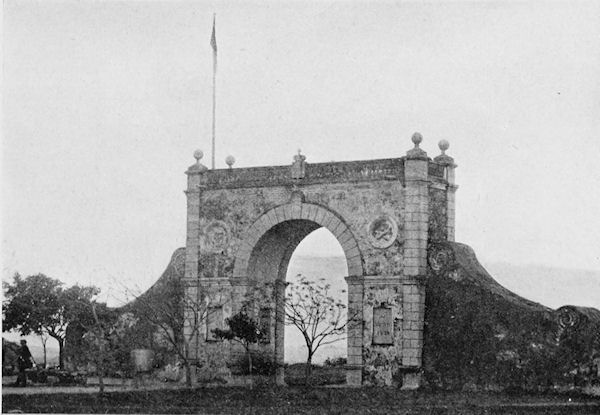
The colony has a population of perhaps eighty thousand persons, and practically all these are Chinese. There are, of course, a few score of civil and judicial functionaries springing from the mother-country; and, as in all places where Europeans have long lived in friendly association with Orientals, the Eurasian class is strikingly numerous. In no court on the Tagus are the laws of Portugal construed with more tenacity and precision than in Macao's chambers of justice; and the flag of Portugal floats over the homes of hundreds of loyal subjects who know only in a hazy manner where Portugal really is—they are rich Chinese and others evading the Chinese tax collector, or escaping burdensome laws, and for many years these crafty Mongols have made a sort of political Gretna Green of Macao. Certain influential Chinamen carrying on business in Canton or other southern communities live in almost regal splendor in Macao, and when the minions of the Chinese government attempt to hale them before a tribunal of law, or compel them to share the expense of carrying on the administration of a province, they exclaim in Chinese, "Oh, no; I'm a subject of the King of Portugal"—and prove it. The great sugar planter of the Hawaiian Islands, Ah Fong, whose Eurasian daughters were beautiful and accomplished enough to find splendid American and European husbands, was a subject of the Portuguese crown, strange to say. His domicile on the Praia Grande is one of Macao's proudest mansions. |
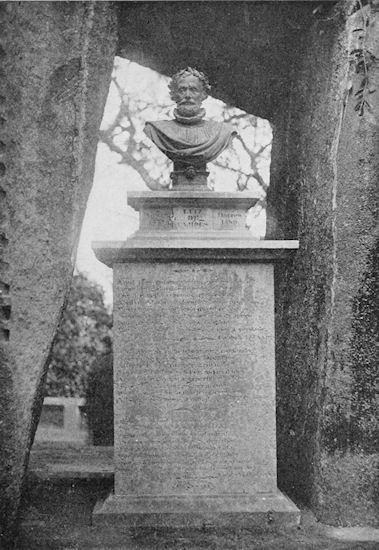 |
| Bust of Camoens |


 |
| Parte de documento oficial de 1915 |
 |
| Símbolo do Consulado Geral de Portugal em Cantão (pós- 1910) |


