
Mostrar mensagens com a etiqueta hotel lisboa. Mostrar todas as mensagens
Mostrar mensagens com a etiqueta hotel lisboa. Mostrar todas as mensagens
quinta-feira, 20 de novembro de 2025


sábado, 8 de novembro de 2025
Dois postais ilustrados da Praia Grande no início da década 1970

Têm por base fotografias feitas na Av. da República na zona conhecida como "Meia-Laranja" / "Sam Ka Tchun", junto ao edifício da Cruz Vermelha. A zona era uma reentrância semicircular que se estendia para o mar semelhante a metade de uma laranja (ou de um círculo).
Na baía podem ver-se algumas estruturas relacionadas com a construção da primeira ponte Macau-Taipa (inaugurada em Outubro de 1974). Ao fundo, entre outros edifícios, o Liceu e o Hotel Lisboa inaugurado em Fevereiro de 1970.

quinta-feira, 15 de junho de 2023
Acessos à nova ponte Macau-Taipa: década 1970

Com a inauguração da Ponte Macau-Taipa (Gov. Nobre de Carvalho) em Outubro de 1974 foi preciso antecipadamente proceder a algumas alterações nas rodovias de acesso. Neste pormenor de uma planta de ca. 1970 podem ver-se algumas das novas configurações, nomeadamente a rotunda em redor do Monumento/Estátua do Gov. Ferreira do Amaral, frente ao Hotel Lisboa e acesso principal à ponte do lado da cidade de Macau.

Nesta altura o casino/hotel Lisboa só tinha pronta a primeira fase. A imagem acima é de ca. 1975. Em 1º plano o edifício do Liceu. Atrás a nova configuração da rotunda Ferreira do Amaral com a estátua ao meio.
sábado, 20 de maio de 2023


segunda-feira, 24 de abril de 2023
Restaurante "Lisboa" (Hotel Lisboa)
Na edição de 1970 do livro "Macau de Hoje" informava-se que "Para acomodar os visitantes dispõe Macau de 84 estabelecimentos hoteleiros". O número era maioritariamente composto por hospedarias, pousadas e alguns hotéis. Destes últimos destacava-se o Hotel Lisboa "na sua magnífica e dominadora imponência e no seu luxo", destacava o livro, propriedade da Sociedade de Turismo e Diversões de Macau.
 |
| Lai Si do Restaurante Lisboa |
O "Lisboa" fora inaugurado em Fevereiro desse ano. A oferta hoteleira do tipo 'ocidental' era ainda composta pelo Estoril, Matsuya, Bela Vista, Caravela e Riviera (este últimos dois quase a encerrar).
 |
| Stanley Ho em 1974 no Restaurante Lisboa |
Quando foi inaugurado o Hotel Lisboa dispunha de 333 quartos e seis restaurantes. Um deles era o "Lisboa", o mais luxuoso de todos e que passaria a ser o cenário das grandes recepções oficiosas a convidados estrangeiros e aos governadores, quer fosse à chegada ou à partida, quer durante períodos festivos como o Ano Novo chinês.

Entre os vários restaurantes dentro do Hotel Lisboa contavam-se o Caesar's Palace, Chiu Chow, Galera, Furusato, Portas do Sol, etc...
 |
| Entrada do Restaurante Lisboa ca. 1974 |
sexta-feira, 31 de março de 2023
"Magical Macau"
Joy e Len Rutledge assinam este artigo publicado a 3 de Novembro de 1978 no jornal "Papua New Guinea Post-Courier". Aborda, entre outros temas, os na altura novíssimos jetfoil, o hotel Lisboa (inaugurado 8 anos antes), os casinos... Inclui duas fotografias: Igreja S. Domingos e Casino Flutuante.

Magic and intrigue seem to go hand in hand with our thoughts of the Orient. We dream of smoke - filled rooms where shadowy figures plan deals worth millions or dream up plots to os, overthrow the world - Nowhere are these thoughts put more to the test than in Macau, that tiny Portuguese enclave on the south coast of China.
Our recent visit to Macau dispelled some notions that had been harboring in our minds but much of the magic, and intrigue remains. Here on the back porch of the People's Republic of China are rococo churches and tiled roof-houses, winding; cobblestone streets and sidewalk cafes, cannon - studded fortreses and old men wearing berets.
It was here that East and West first met. Their embrace started a love affair that continues to this present time. This is the oldest permanent European settlement in Asia. It's diverse people appear now to live together in peaceful and harmonious co-existence. It was not always like this. Macau remains a mystery to many. You look up an airiline time-table and you don't find it listed, for Macau has no airport. No cruise ships will list it as a port of call and there is no railway.
Unless you are a Communist Chinese, the only way to visit Macau is by boat from Hongkong. In fact there are three choices. The leisurely way is the 3 hours crossing by ferry. The popular way is the 75 minute trip by hydrofoil. We went the so-called exciting way by Boeing jetfoil.
The jetfoil ride is an experience in itself. These revolutionary craft "fly" on underwater wings. The result is the fastest and smoothest luxury passenger sea transport in the world.
Macau, like Lisbon and Rome, is built of seven hills and like those famous cities it too has a glorious and somewhere tempestuous past. The city has grown up with a Portuguese ambience which is proudly displayed in the charm of its buildings. its traditions and its religious festivals. But it is also a very Oriental city, alive with the pulsing rhythms of China, ancient and modern.
Macau is perhaps the most distinctly Chinese place left anywhere in the world. Or perhaps it is just what we Westerners would like China to be? 'We asked Gloria Azedo, our guide from the
Tourist Department, what she thought. Her answer confirmed our thoughts. "In China, the character of the cities: has been largely changed by modernisation and low cost housing programs and many old Chinese institutions have been sunweased there as remnants of the past."
In Macau, they all survive and in fact many thrive. There are the small Buddhist and Confucian temples, the traditional lotteries, the many pawnshops and markets and the timeless fishing junks at rest in the harbor.
Macau is surrounded by China. Through the border gate flows a steady stream of food, water and supplies. The so-called bamboo curtain seems hardly to exist here. We watched trucks with dual Macau and China number plates passing through the border with hardly a glance from the guards.
Clearly Macau, could not exist without the close co-operation of China. We wondered just how much, influence China has on life in Macau. There are stories of deals, of Red Chinese control of many activities, but no one will, feall'y say.
Equally Macau in its present form could, not exist without gambling. It is currently the gambling mecca of the Far East. Macau has always existed by doing things that others considered too daring, dangerous or devious. At other times its major source of income has come from the illicit trade in gold and opium, acting as a middleman in the profitable China-Japan trade when the Chinese were forbidden to trade with Japan and from its opium dens, easy women and unregulated gambling halls.
All but the gambling has gone, but as if to compensate for the lost, notoriety gambling has diversified into virtually every form imaginable and its all legal and more highly organised, than ever before.
As the jetfoil approached the shore Macau looked as sleepy, as picturesque and anachron existeally colonial, as anything described by Somerset Maugham with one glaring exception. The exception is the improbable 600 room Hotel Lisboa, whose architecture should only exist in Disneyland, and the adjacent road bridge which rises in curved splendor to pass over the shallow muddy waters of the Pearl River Estuary.
Once you are ashore the atmosphere rapidly surrounds you. A stroll along the waterfront boulevard with its century old trees is a delightful experience. Turn a corner and in a moment you leave the Chinese vessel fishing scene and enter a world of pastel colored "palatios", 17th century-churches and-towering ruins that sneak of Europe.
You can stroll for a whole morning thourgh the humpbacked alleyways and barely see a European face, yet around the corner are avenues lined with ancient banyan trees which should only exist in Meditarreanean Europe.
Gambling in Macau never stops and, once in Macau, it is almost impossible to avoid a visit to a casino. All city tours include a stop on the itinerary and even if you decide to see Macau on foot we strongly advise you to visit either the casino in the Hotel Lisboa or the floating Macau Palace.
The Lisboa casino has a quiet luxury about it with its carpeted softly clean and well ordered rooms. The floating casino, which was featured in the James Bond film "Man with the Golden Gun", has a more exotic Chinese style of decoration and certainly more noise. There is no entrance fee or formality and without spending a dollar you can watch little old ladies rubbing shoulders with, systems operators and raw tourists.
Distinctions of race, culture and language disappear when the chips are down; then they are all simply gamblers. You will either find the casinos invigorating or depressing. We confess to finding the fanatical gamblers - engaged in - a rather squalid pastime and our stay was fairly short.
domingo, 19 de março de 2023
Acácias Rubras na Av. Infante D. Henrique

Neste postal ilustrado do Hotel Lisboa na década de 1980 visto da Av. Infante D. Henrique, entre o Liceu e o Campo dos Operários, para além da fila de táxis, destacam-se as acácias rubras que cobriam Macau de vermelho, nomeadamente nos meses de Maio a Julho.

quarta-feira, 17 de agosto de 2022
The Hotel - Casino Lisboa is due to open in 1969

The Hotel - Casino Lisboa is due to open in 1969 - a year or so behind schedule because of the 1966-1967 troubles. Mr. Stanley Ho's syndicate today is operating mainly in the Macao Palace, an old floating restaurant. (...)*
Excerto de uma notícia de 1964
* seria inaugurado em Fevereiro de 1970
A fotografia é de 1986 numa altura em que cerca de 4 milhões de turistas visitam o território anualmente, 80% dos quais oriundos de Hong Kong.
Por esta altura o Lisboa foi ampliado passando a ter mais 460 quartos. Actualmente tem cerca de mil.
"Shortly afterwards we came to the huge Lisboa Hotel – a garishly - coloured structure of imperial yellow tiles and a front entrance of unusual design. Here, we were later to discover, is the home of the biggest casino in Macau. (...)"
in China Tourism, 1986
quarta-feira, 13 de abril de 2022
Crazy Paris Show: 2ª parte
 "Behind that doomed hidalgo rears the lemon yellow hotel, crowned by a great globe studded with luminous spikes. The Lisboa, built in the 1960's, was the first of the modern hotels.* It presents Macao's most extravagant cabaret, modeled on the strip shows of the Crazy Horse Saloon in Paris.
 The showgirls are all Australian, American and European Caucasians with not an Asian among them, which says something about the extracurricular taste of the overwhelmingly Asian and male audiences.
The center of the Lisboa is the two-story casino, one of the six authorized in Macao. In addition to the eight ways to lose money in casinos, including one-armed bandits, here called ''hungry tigers,'' there is jai alai, greyhound racing, horse racing and, once a year, the Macao Grand Prix, which attracts drivers and bettors from all over Asia."
Segue-se a tradução deste excerto de um artigo do jornal The New York Times de Setembro de 1990.
"Atrás daquele fidalgo condenado ergue-se o hotel amarelo-limão, coroado por um grande globo cravejado de pontas luminosas. O Lisboa, construído na década de 1960*, foi o primeiro dos hotéis modernos. Apresenta o cabaré mais extravagante de Macau, inspirado nos espectáculos de strip do Crazy Horse Saloon em Paris. As dançarinas são todas australianas, americanas e europeias, sem nenhum elemento asiático entre elas, o que diz algo sobre o gosto extracurricular do público predominantemente asiático e masculino.
O ponto nevrálgico do hotel Lisboa é o casino de dois andares, um dos seis autorizados em Macau. Para além das oito formas de perder dinheiro em casinos, incluindo bandidos de um braço só, aqui chamados de ''tigres famintos'', há jai alai (pelota basca), corridas de galgos, corridas de cavalos e, uma vez por ano, o Grande Prémio de Macau, que atrai pilotos e apostadores de toda a Ásia."
* foi construído no final década de 1960 e inaugurado em Fevereiro de 1970

O que começou por ser um espectáculo pensado para apenas dois meses transformou o clássico Teatro D. Pedro V - paredes meias com a igreja de Sto. Agostinho e o Seminário de S. José - na sala de visitas da noite 'erótica' em Macau à boa maneira ocidental e a imitar as congéneres parisienses.
O Crazy Paris Show foi ali exibido entre 1979 e 1986 ano em que o espectáculo erótico – com as mais belas dançarinas europeias – passou para a sala Mona Lisa do Hotel Lisboa.
Como se pode ler no anúncio abaixo (de 1994) "the best artistic show in the world" estava na altura no quinto ano de gloriosas exibições diárias nocturnas ("in it's 5th glorious year nightly at the Dom Pedro V Theatre".)

Anúncio publicado na imprensa de Hong Kong em 1984.
Nesta época havia dois espectáculos nocturnos aos dias de semana e três ao sábado
A pensar especialmente nos turistas de Hong Kong a Agência de Viagens Sintra Tours, também da STDM, proporcionava um pacote que incluía bilhete para o espectáculo, viagem de jetfoil (regresso a Hong Kong nesse dia antes da meia noite e jantar chinês; opcionalmente o viajante podia pernoitar em Macau no hotel Sintra (tb da STDM) com pequeno-almoço incluído.


Em 1986 o espectáculo erótico - com as mais belas dançarinas europeias - passou a realizar-se no Hotel Lisboa. Na década de 1990 funcionava na sala Mona Lisa do Hotel Lisboa. Em 1999 bilhete custava 120 patacas.


Anúncio na imprensa: 1989


segunda-feira, 23 de agosto de 2021
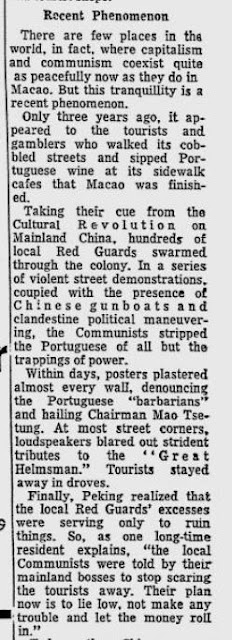
"Macao Still Outpost of Capitalism"


"The Chinese,", says onde resident, "could take this place with one phone call any time". But hey haven't taken Macao and the reason, ironically enough for disciples of Karl Marx, is purely and simply crass materialism. The little colony is a fiscal gold mine and Peking would surely lose much more that it could possibly gain by swalling it up.
As the Monte Carlo of the East, Macao attracts thousands og eager gamblers and tourists from all over the world to its casinos and famous dog track. And as the behind-the-scenes power, the Communists rake in millions of dollars a year from the money these visitors shell out at roulette tables, betting spots and tourists shops.
There are few places in the world, in fact, whre capitalism and communism coexist quite as peacefully now as they do in Macao. But his tranquility is a recent phenomenom.
Only three years ago, it appeared to the tourists and gamblers who walked its cobled streets and sipped Portguese wine at its sidewalk cafes that Macao was finished.
Taking there cue from cultural Revolution on Mainland China, hundreds of local Red guards swarmed through the colony In a series of violent street demonsgtrations coupied with the presence of Chinese gunshots and clandestine political maneuvering the Communists stripped the Portuguese of all but the trappings of power. (...)
Finally Peking that the local Red Guards excesses were serving only to ruin things. (...) Nothing is done without Peking's permission. this power is exercised chiefly through the local chamber of commerce which is dominated by a mysterious millionaire named Ho Yin.
Ho has the unique distinction of being a practicing capitalist and a dedicated Communist. (...)
With the new rapproachement, a Riviera-like calm once again prevails in Macao. And the colony is enjoying a general economic boom, epitomized by the new, high-rising, 333-room Lisboa luxury hotel. (...)
209 new businesses were started last year most of them shops and small factories making and selling everything from binoculars to insense. (...)
When the two-mile bridge is completed from Macao to the islands of Taipa and Coloane, some 4 1/2 square miles of underpopulated land will be available for business, residential and resort development. (...) Probably nowhere else in the world can signs advertising American cars, English cigarettes and Japanese watches be seen interspersed with official posters proclaiming "Long Live The communist Party" and "Long Live Chaiman Mao".
Reading Eagle - 22.07.1970


terça-feira, 13 de julho de 2021
"Colony prepares for heavy influx of tourists"

"The people of Macau are gearing up with new tourist services and facilities for the onslaught that is bound to come. (...) The 300-room Hotel Lisboa, which opened some rooms in 1970 but went into full operation only last year, has done much to upgrade the hotel scene. It attractively perched by the sea, and its main tower which looks for all the world like a frosted wedding cake - can be seen from most vantage points in the city. (...)"
The Financial Post. 25.3.1972 |
| Hotel Lisboa: inaugurado (parcialmente) em Fevereiro de 1970 |
A ligação de helicóptero entre Macau e Hong Kong chegou a ser equacionada pela STDM mas não avançou nesta época, só muitas décadas mais tarde. O artigo refere ainda a particularidade do turista poder ver e ouvir fado no hotel Lisboa. Quanto à restante oferta hoteleira do tipo ocidental surgem os nomes da Pousada Macau e dos hotéis Estoril e Bela Vista. Em 1972 o hotel Riviera fechara portas recentemente e o hotel Sintra ainda estava em construção. Havia ainda o Matsuya e o Caravela, este último por pouco tempo.
segunda-feira, 26 de abril de 2021
"Macao Gambling Differs From Las Vegas Variety"
Curioso por saber como era o cenário dos casinos nos primeiros anos da década de 1970, incluindo o ambiente que se vivia no Casino flutuante ou nas salas de jogo do hotel Lisboa?
Fica a sugestão para ler este artigo da autoria de Kenneth Englade (da agência de notícias UPI) publicado no jornal dos EUA, Sarasota Herald-Tribune a 13 de Abril de 1975.

Macao Gambling Differs From Las Vegas Variety
Macao (UPI) - Gambling is a big business in Macao, a tiny flyspeck of an island 40 miles southwest of Hong Kong within spitting distance of China. But de action is not quiet at the Las Vegas pace. (...)
quarta-feira, 3 de junho de 2020
Carteiras de fósforos da SNF: década 1970
Nas imagens estão duas vistas de Macau - Casino flutuante Macau Palace e Hotel Lisboa - que faziam parte de uma edição especial de carteiras de fósforos da Sociedade Nacional de Fósforos (Lisboa, Portugal) dedicadas ao Ultramar.

Dois símbolos da indústria do jogo na década de 1970 em Macau


Existe um novo desde 2019 no Cotai
quinta-feira, 16 de abril de 2020
O "boom" turístico da década de 1970

O Hotel Lisboa (1970), o Hotel Sintra (1974) e o Casino Jai Alai (1975) são os grandes empreendimentos turísticos da década de 1970. A par da ponte que ligou a península à ilha da Taipa, inaugurada em Outubro de 1974, e do istmo que ligou as ilhas da Taipa e Coloane, no final da década de 1960.
 Com os efeitos da Revolução Cultural chinesa no território mais apaziguados, muito devido aos investimentos da STDM, Macau dava um passo decisivo na indústria do turismo. A par dos novos hotéis, havia uma nova frota de 17 hydrofoil que faziam a ligação marítima entre Macau e Hong Kong em apenas 75 minutos.
 Em 1976 um total de 2,5 milhões de turistas (perto de 2 milhões de Hong Kong) visitaram Macau.


Clicar nas imagens para ver em tamanho maior


Casino Flutuante e Hotel Lisboa ao fundo

Casino Jai Alai e Hotel Sintra:
dois empreendimentos que nasceram na década de 1970

terça-feira, 4 de fevereiro de 2020
O 'boom' económico da década de 1970
A propósito do post de ontem, publico hoje um artigo intitulado "Booming Macao Belongs to Portugal, but Chinese Residents - and Peking - Call Tune", da autoria de Joseph Lelyveld, publicado no jornal The New York Times a 29 de Setembro de 1973.
A década não poderia ter começado da melhor forma em termos económicos para Macau, realça o jornal norte-americano falando do "primeiro boom económico em quase 300 anos". E os números das exportações são prova disso.
 Veja-se o quadro ao lado (não faz parte do artigo). Entre 1970 e 1975 o valor triplicou! Junte-se a estes dados, os hotéis e casinos criados entre 1970 1975: hotel-casino Lisboa, hotel Sintra, Casino Jai Alai, etc... a inauguração da primeira ponte entre Macau e a Taipa (Outubro de 1974).
E eram os casinos a sustentar grande parte do boom económico com seis casinos abertos 24 horas por dia. Num território com cerca de 250 mil habitantes os turistas oriundos de Hong Kong superavam os 1,5 milhões, isto numa altura em que a colónia britânica tinha apenas 4 milhões de habitantes.
O mote do artigo reflecte ainda o quanto a sociedade se ressentia de tantas mudanças pelas quais passava. No início do artigo pode ler-se: "O minúsculo posto avançado de Portugal na costa do sul da China está experimentando seu primeiro boom económico em quase três séculos, mas os portugueses locais sentem-se confusos e até tristes."
E continua:
 Veja-se o quadro ao lado (não faz parte do artigo). Entre 1970 e 1975 o valor triplicou! Junte-se a estes dados, os hotéis e casinos criados entre 1970 1975: hotel-casino Lisboa, hotel Sintra, Casino Jai Alai, etc... a inauguração da primeira ponte entre Macau e a Taipa (Outubro de 1974).
E eram os casinos a sustentar grande parte do boom económico com seis casinos abertos 24 horas por dia. Num território com cerca de 250 mil habitantes os turistas oriundos de Hong Kong superavam os 1,5 milhões, isto numa altura em que a colónia britânica tinha apenas 4 milhões de habitantes.
O mote do artigo reflecte ainda o quanto a sociedade se ressentia de tantas mudanças pelas quais passava. No início do artigo pode ler-se: "O minúsculo posto avançado de Portugal na costa do sul da China está experimentando seu primeiro boom económico em quase três séculos, mas os portugueses locais sentem-se confusos e até tristes."
E continua:
"Houve um tempo em que todos os edifícios da Praia Grande, a avenida sombreada à beira-mar, compartilhavam a mesma inspiração. Agora, muitos deles estão sendo demolidos e substituídos por apartamentos indescritíveis, inspirados em nada além da promessa de um retorno rápido. Os arrependimentos que os portugueses sentem pelos edifícios antigos e por um modo de vida que está a desaparecer são aprofundados pelo facto de que irão colher muito pouco desses retornos, pois o boom de Macau é praticamente um fenómeno puramente chinês".
 |
| A imagem não faz parte do artigo |
Macao, Sept. 22 — Portugal's minuscule outpost on the South China coast is experiencing its first economic boom in nearly three centuries, but the local Portugeese are cast in the role of bemused, even mournful bystanders. "Macao is no longer Macao,” lamented an official in the shuttered Governor's office, a spacious colonial structure, whose facade has been washed in a delicate pink pastel inspired by the memory of some distant Iberian port.
The Talk of Macao
There was a time when all the buildings on the Praia Grande, the shaded waterfront avenue on which it stands, shared that same inspiration. Now many of them are being pulled down and replaced with nondescript apartment houses inspired by nothing but the promise of a fast return. The regrets the Portuguese feel for the old buildings and for a vanishing way of life is deepened by the fact that they will share in very little of those returns, for Macao's boom is almost purely a Chinese phenomenon.
Chinese Money Everywhere
Chinese capital is behind the apartment houses, just as it is behind the casinos, the fleet of hydrofoils that come skimming across the muddy Canton River estuary with gamblers and tourists from Hong Kong, the textile factories and impressive plans for further investment.
Part of the money is local; much of it comes from Hong Kong. Investors are confident because they believe that the Chinese Government in Peking has no plans to renounce the perpetual grant of six square miles that the Portuguese finally obtained from the Ching Dynasty in 1887 - after they had already been here for 330 years. And they also know that Peking will not allow Portugal to exert what remains of her tattered authority.
In practical terms, this means that business and personal taxes will stay low and that it will remain a simple matter to shift profits out of the territory without ever entering them on the ledgers of a Portuguese bank. Portugal has no diplomatic relations with China, no leverage and no illusions, for China exhibited her control of the local population at the start of the Cultural Revolution in, 1966, when local Red Guards rioted.
Of the population of about 250,000, fewer than 7,500 are classified as Portuguese, and of those fewer than 1,000 are actually Portuguese from Europe. The rest are Macaenese — Portuguese‐speaking Eurasians who are said these days to be forsaking a distinctive patois and cuisine maintained for several hundred years. After the centuries of Portuguese rule, few Chinese here know Portuguese, which is not even taught in their schools. Most Portuguese find it necessary, however, to know some Cantonese.
The spectacle of a captive colonial power, and a good investment climate based on the Cultural Revolution may seem anomalous, but there is nothing much new in the situation for the Portruguese, who have not really flourished here since 1685, when they lost their monopoly on trade with Canton.
Until the Opium War, the Ching Dynasty kept a mandarin in Macao to supervise the local population and exercise discreet veto power over colonial officials. Now that role is played by Ho Yin, a local capitalist who is chairman of the board of the Tai Fung Bank and a number of other enterprises, and a frequent visitor to Peking.
Mr. Ho and others who have been quietly entrusted with the task of exercising authority make sure that no organization hostile to the Chinese Government gets started here, that the Portuguese refrain from taking in refugees, that most secondary‐school students attend Communist ‐ sponsored schools; and that the local press carries no editorials critical of Chinese policies.

Accepted by Portuguese
“They have all the power,” the Portuguese say in acceptance of a fact too obvious to be belabored. As one official put it: “The Chinese know our number. They have only to lift up the phone and say, ‘We don't want you people there anymore’ Of course the next day we'd be gone. What else could we do?” Probably the main reason that such a call has not been placed and is not likely to be - despite Peking's strong support of anti‐Portuguese movements in Africa - is that the ouster of the Portuguese would upset the equilibrium of the British colony of Hong Kong, which has a vital importance to China for commercial and banking reasons and also because it provides an avenue for communication with the overseas Chinese. Having decided to allow Macao to maintain a separate existence, Peking seemingly has no choice but to allow it to prosper in the only way it can - by attracting capital from Hong Kong.
Much of the boom is founded on Hong Kong's laws against gambling. This year there will be more than 1.5 million visits to Macao by Chinese from Hong Kong, which has a population of only four million. The overwhelming majority are lured here solely by the six casinos, which never close.
By any standard, the gambling is ferocious. A few weeks ago a young Chinese man walked away from the baccarat table at the Lisboa Hotel after having won $234,000 in one sitting. As a result of such exploits, the Chinese managers of the gambling syndicate recently thought it prudent to reduce the maximum baccarat bet to $12,000.
The Lisboa sits on the Avenida do Dr. Oliveira Salazar and boasts among its dozen restaurants one called the Portas do Sol, where Portuguese fado music is performed nightly. But the suggestions of Portugal are as synthetic as they would be if the hotel had been set down in Las Vegas, its real inspiration. A garish structure surfaced in golden tiles, the hotel is crowded by a large concrete sculpture that looks as if it was meant to suggest a helicopter landing on a giant artichoke; actually it is meant to suggest a roulette wheel, symbolic of the new Macao.
Virtually from the hotel's front door, a long concrete span stretches towards two thinly populated islands, Taipa and Coloane, which account for about half Macao's area. The bridge is due to be finished in the spring, and Chinese entrepreneurs are already lining up withiplans for an industrial park, a deepwater harbor, a new resort and, of course, another casino. What is in it for the Portuguese? Financial officials say that Portugal's only direct expenses on Macao are the cost of the bridge, given as a development loan to be repaid with interest, and the $34,000 she contributes annually to the upkeep of the missionary schools.
Traditional Gifts
In return, they say, Macao sends to Portugal a $100,000 contribution for the upkeep of a botanical garden and a hospital for tropical diseases in Lisbon, a traditional extraction, it is said, from the country's “overseas provinces.” Macao's trade with Portugal and her overseas territories is actually slipping. Not even 2 per cent of her imports comes from the supposed mother country, which takes only 8 per cent of her exports. But officials here all insist that the benefits of Macao to Portugal cannot be measured - that it is, as one put it, “cultural and moral“ - a necessary piece of evidence that Portugal is grander than she appears to be on the map of Europe. “You have to be inside Portuguese tradition and history to understand,” said a Macaenese who ranks high in the administration. Asked about Macao's prospects, this official replied with a slight shrug, “There is no logic in politics,” then drew what for him was the logical deduction. “Our future must be very bright,” he said.
segunda-feira, 3 de fevereiro de 2020
Hotel Lisboa: meio século em Macau

Esta é provavelmente a primeira maqueta/proposta arquitectónica para o que viria a ser o Hotel/Casino Lisboa. Em 1962, o novo espaço ainda não tinha sido baptizado, e seria bem diferente o resultado final. (ver imagem abaixo)
Numa ‘acção de charme’ junto do novo governador (desde Abril de 1962 a Novembro de 1966) Stanley Ho “director-geral, cumprimenta e saúda Sua Exa. o Governador Ten-Cor. António Lopes do Santos desejando-lhe um feliz e próspero governo”.
Lopes dos Santos e Stanley Ho ‘mudaram’ a face do jogo e turismo de Macau: o primeiro atribui-lhe o monopólio do jogo (em 1962) e aumentou muitíssimo as receitas para os cofres do governo; e o segundo ‘ocidentalizou’ os casinos ajudando a colocar Macau no mapa do turismo mundial.

Há 50 anos, a 3 de Fevereiro de 1970, era inaugurado o Hotel Lisboa, um dos vários hotéis da STDM. Foi o primeiro 'resort integrado' do território e o mais luxuoso de todos. Na época até se dizia "um luxo luxuoso...", "luxo de pelúcia" e "uma extravagância"
Em termos arquitectónicos o edifício era imponente e na altura era o maior naquela zona de aterros.

Uma pequena cidade dentro da cidade: com hotel (306 quartos na fase inicial... 400 posteriormente), casino, restaurantes europeus e orientais, clubes nocturnos, centro comercial, piscinas, centro de diversões, incluindo bowling, piscina, sauna, etc... que veio revolucionar a vida no território que entrava na rota do turismo internacional de massas.
 |
| Em 1974 |
O Casino Lisboa, situado na cave do edifício, seria inaugurado apenas em Junho de 1970. Dos 3 200 429 passageiros que se movimentaram, em 1971, entre Macau e Hong-Kong, 2 594 814 eram chineses, dos quais a grande maioria residia naquele território britânico. Estrangeiros foram 530 mil um número nunca antes registado. O sucesso foi de tal ordem que a STDM teve de construir quase de imediato mais um hotel. Como já existiam planos para construir um edifício não muito longe do "Lisboa", o mesmo deixou de ser para fins residenciais e passou a hotel inaugurado em 1974. Seguindo a tradição de nomes de localidades portuguesas, Stanley Ho chamaria este de "Sintra".
 |
| Detalhes da finalização da obra |
O hotel era apenas uma das faces visíveis do contrato de concessão da exploração dos Jogos de Fortuna e Azar iniciado em 1962 pela STDM de Stanley Ho e associados. O bacará foi um dos jogos que se tornou uma imagem de marca do novo casino passando logo no início a representar 37% do mercado. Em 1984 já representava 65%...
A par do Lisboa em 1970 a STDM tinha ainda o hotel Estoril (inaugurado em 1963 tb com casino) e o flutuante Macau Palace.
Excerto de um artigo do The New York Times em 1973:
"The Lisboa sits on the Avenida do Dr. Oliveira Salazar and boasts among its dozen restaurants one called the Portas do Sol, where Portuguese fado music is performed nightly."
Excerto de um artigo do The New York Times em 1973:
"The Lisboa sits on the Avenida do Dr. Oliveira Salazar and boasts among its dozen restaurants one called the Portas do Sol, where Portuguese fado music is performed nightly."

Anúncio de 1980: "O Grandioso Hotel Casino Lisboa. O Mais Deslumbrante Hotel do Oriente com as melhores acomodações, divertimentos e restaurantes".
Nesta época já tinha 10 restaurantes, incluindo o Galera, Furusato e Portas do Sol.
Subscrever:
Mensagens (Atom)