Mostrar mensagens com a etiqueta ópio. Mostrar todas as mensagens

quinta-feira, 19 de setembro de 2024

Uma "Vue de Macao" pouco ou nada plausível

L. Sevin-Desplaces assina o artigo "En Chine", publicado ao longo de várias edições da publicação francesa "Magasin d'éducation et de récréation - journal de toute la famille" no ano de 1864. A ilustração "Vue de Macao" parece pouco plausível já que nada tem a ver com as ilustrações da época sobre Macau. Será Hong Kong ou Cantão?
Excerto
Les récits du voyageur vénitien traduits en plusieurs langues étaient tellement sédui sants qu on les crut exagérés Ils ont été depuis amplement justifiés. Ce ne fut qu'après les découvertes de Vasco de Gama que les Portugais eurent les premiers des relations commerciales avec la Chine. En 1557 ils prirent diplomatiquement possession du territoire de Macao et y fondèrent la ville de ce nom. 
Macao bâtie en amphithéâtre sur une petite presqu'ile avec un quai de 2 kilomètres de longueur est accessible par deux baies malheureusement sans profondeur et trop ouvertes. La ville se compose de maisons petites et tristes qui bordent des rues étroites et  tortueuses au pavé caillouteux. Le voisinage de Hong Kong beaucoup mieux située lui a toujours nui. Il ya pourtant à Macao 60,000 Chinois 4,000 Portugais macaïstes descendants des premiers colons et 1,000 Portugais européens dont la moitié forme la garnison.
On montre à Macao le jardin de Camoëns sur l'emplacement duquel séjourna le poète alors qu'il remplissait dans la colonie les fonctions de curateur aux successions vacantes vers 1559 Camoëns y resta dix huit mois et y composa une partie de ses Lusiades.
C'est à son retour en Europe de Macao à Goa qu il fit naufrage et perdit tous ses biens sauf le manuscrit de son poème. Sur l'emplacement de sa maison s'élève aujourd hui l'arsenal militaire entouré de superbes jardins. On y montre l'Observatoire de Camoëns, espèce de guérite de pierre à coupole où le poète se livrait dit on à des études astronomiques*. 
Ajoutons que depuis 1848 les Portugais ne payent plus à l empereur de Chine les cinq cents taëls de loyer qu ils étaient assujettis de verser pour l'occupation du territoire de Macao. Un siècle plus tard les Hollandais entrent en concurrence avec les Portugais. En 1622 ils s'emparent de l'archipel des Pong Rou dans le canal de Formose, grande île avec laquelle les Chinois avaient pris contact en 1403 et fondent un établissement militaire et commercial à Taï Ouan Fou, aujourd hui en ruine.
Ils en furent expulsés en 1661. Puis vint l'Angleterre qui dès qu'elle fut maîtresse de l'Inde introduisit son opium en Chine. En 1798 la Compagnie des Indes y importait déjà 4,170 caisses d'opium d'une valeur de 4,327,850 francs. En 1833 dernière année du privilège commercial qu'elle avait obtenu elle en importait 10,864 caisses d'une valeur de 30,883,905 francs. On voit que le trafic était fructueux. Pourtant les empereurs chinois avaient été avisés des désordres graves qui résultaient pour leurs sujets de la consommation de ce poison Ils en proscrivirent l'emploi et en 1839 l'empereur Tao Kouang prit des mesures contre les négociants anglais ven deurs d'opium.
Les tribunaux chinois de Hong Kong firent un procès à ceux établis dans cette localité foyer principal du commerce étranger. Ils exigèrent que tout le stock d opium en maga sins leur fût livré pour être détruit. Mais le gouvernement anglais protesta par la menace d'une déclaration de guerre et demanda en manière de réparation le droit formel de vendre son opium trente millions d'indemnité et la cession de l'îlot de Hong Kong. Cette cession eut lieu le 20 janvier 1841.  (...)"
* confusão com o ponto de observações astronómicas criado na propriedade onde ficava a Casa Garden no final do século 19 pela expedição francesa de La Pérouse.

domingo, 14 de abril de 2024

Macao Opium Monopoly: 1924

Esta notícia de 16 de Maio de 1924 informa que foram recebidas quatro propostas para o "monopólio do ópio" para um "período de três anos" a partir de Julho. A proposta de valor mais alto foi feita pela Yu Sing Company que ofereceu mais de duas mil patacas por ano. Um dos sócios da empresa era Vong Tchi Sun.
The Hong Kong Telegraph 16 Maio 1924

domingo, 24 de março de 2024

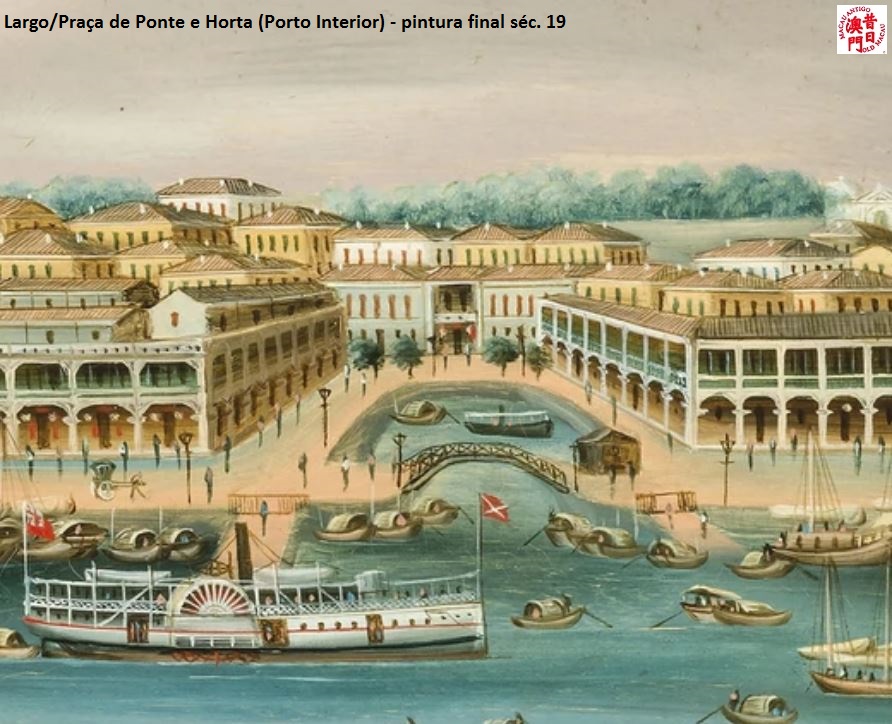
Largo da Caldeira e Praça de Ponte e Horta


"Finalmente a caldeira da alfandega será trazida ao alinhamento do novo caes dando se lhe portanto mais 336 m2 de superficie muito necessarios para que possa receber e accommodar a esquadrilha do serviço de policia da Capitania do porto. Os detalhes da bocca e accessorios d'estas duas docas encontram-se nos desenhos apresentados no Ministerio. Sobre as boccas das caldeiras da barra e da alfandega lançar-se-hão pontes de ferro fixas de viga recta e com taboleiros de madeira bastando que a face inferior d'ellas fique a 1,5m acima do prea mar ordinario, visto que só serão utilisaveis para pequenas embarcações. Estas pontes manterão ininterrompida a communicação marginal de todo o caes até à fortaleza da barra."
Excerto de "O porto de Macau: ante-projecto para o seu melhoramento", de Adolpho Loureiro, 1884.
Em cima assinalei na planta a área representada na pintura
Para além da Caldeira da Alfândega, outra das legendas da planta da península de Macau em 1889 é a Fábrica do Ópio que ficava no largo/praça de Ponte e Horta, bem como o respectivo armazém cujo edifício ainda hoje existe.
Detalhe da Planta da Península de Macau (1889)

Em "Visões da China" Jaime do Inso escreve: "No Largo de Ponte e Horta, à beira do Porto Interior de Macau, fica um edifício baixo e comprido, com as características de uma antiga edificação portuguesa. É a fábrica do ópio."
Curiosidade: Chegou a existir em Macau a Travessa do Ópio, ia da Rua da Alfândega à Praça de Ponte e Horta.

quarta-feira, 25 de outubro de 2023

"Macao, le 'joyau de l'Orient'"

"Macau, a jóia do Oriente e centro de contrabando de estupefacientes"

in L'Intrasigeant (França), Outubro 1935

segunda-feira, 1 de maio de 2023

A Tour Around the World in 1884

Este excerto refere-se a uma volta ao mundo iniciada em Nova Iorque no final do século 19. O ópio e o tráfico de cules são as principais referências do autor sobre Macau num livro com cerca de 600 páginas. John B. Gorman não chega a ir a Macau.
A view among the hills near Macao, China.

Chapter XLVI From Hong Kong to Canton
Boat life and sightseeing in Canton
We wanted to see an essentially characteristic Chinese city and we could not have selected a better representative than Canton. It is eighty miles up a strong current by two magnificent lines of steam boats that run in opposition to each other. The fare had been reduced as low as one dollar but we paid three dollars each way. Sir John and I were the only first class passengers while below on the first deck there were seven hundred Chinese, many of whom were the élite of society. They paid thirty cents each for the same passage.
Our boat was a magnificent side wheeler two or three decks high purely American in every feature even to the officers who commanded it. The mouth of the Canton River not far from Hong Kong resembled an arm of the sea. There were many junks and boats dotting the vast expanse before us while over to our left some distance away gleamed Macao which for picturesqueness and beauty of situation surpasses even the city of Hong Kong.
In the summer it becomes a kind of sanitarium for the Europeans of the latter city. Macao was among the earliest European settlements in China made by the Portuguese to whom it still belongs more than three hundred years ago. Like Hong Kong, for smuggling opium, Macao has occupied as unenviable a position for its long years of revolting traffic in human flesh. Horrible stories are related of the coolie trade which the Portuguese aided by Chinamen have carried on as defiantly of law. The chief source of supply is from the numerous gambling hells in China where the Chinese having lost every thing else stake their bodies for a small sum of money advanced them by the gamblers. The gamblers then sel а them for twenty or thirty dollars to the barracoon or dealer who doubles his money. I have seen these coolies myself in Cuba brought from this very port while others go on the Pacific coast to Peru delivered there at a cost of two hundred dollars apiece."
Excerto de A Tour Around the World in 1884 Or Sketches of Travel in the Eastern and Western Hemispheres: Embracing an Account of Europe, Egypt, Palestine, India, Ceylon, Straits Settlement, China, Japan, and America. de John B. Gorman, EUA, 1886.

sábado, 4 de fevereiro de 2023

Reportagens na Associated Press em 1946

Hal Boyle assina vários artigos sobre Macau para a agência noticiosa Associated Press em Fevereiro de 1946. Seleccionei dois publicados no San Pedro News Pilot, um jornal da Califórnia (EUA). Versam sobretudo sobre o ópio e o jogo.
Sin on a Crutch Macao, 'Monte Carlo of Far East,' Orient's Run-Down Pleasure Haven
lf ever there was a place that looked like sin on a crutch it is Macao, sometimes fancily referred to as the “Monte Carlo of the Far East.” Less than a century ago this little five square mile Portuguese colony rivaled Hongkong and Canton as the trade center of south China. The coming of deep draft ships, however, robbed its shallow harbor of major commercial importance. Now its industry is founded on fishing and prostitution, incense sticks and opium, firecrackers and gambling. And games of chance are probably the government's chief single source of revenue. Macao, considering its long proud history, is somewhat on its uppers at present. It is a mixture resembling Concord, Mass., Reno and Coney Island - with Chinese overtones. With its neon lights and picturesque old avenues shaded by elderly banyan trees, the colony resembles nothing more than a stately old southern home in Natchez turned into a hot dog stand. Portugal near the close of the 15th century was the iirst European maritime power to open direct trade relations with China and Macao was founded about 1557 after an earlier trade station had been destroyed. It lies about 50 miles west of Hong Kong on the southern tip of Chung Shan island district in the Pearl river estuary. 
Claims to Fame
It has many claims to historical fame —and likes to emphasize them. For centuries it was one of the chiel trade centers with China and Japan and the fountainhead of Catholocism in the Far East, serving as a headquarters.for missionaries. It was here the first European hospital in the Far East was founded in 1569. Caleb Cushing also signed the first American treaty with China here in the “Queen of Heaven” temple in 1844 and in 1864 the colony built the first lighthouse in China. Dr. Sun Yet-Sen, China’s George Washington and founder of the first republic, also practiced medicine as a young man in Macao’s Chinese hospital. Macaons like to recall that the first observations by which Paul De Lamanon, French socialist, was able to prove that the intensity of magnetic force varies at dilferent parts of the earth were made here and in Tenerife between 1785 and 1787. They also boast that while Portugal was under Spanish rule from 1581 to 1640 Macao alone among Portuguese possessions never hauled down the national flag. They even beat off a 19-ship amphibious landing by Dutch forces in 1622, thanks to the artillery generalship of a Jesuit priest. 
Past Glories Meaningless 
All these past glories mean little now to tired Hong Kong and Canton businessmen who like to use Macao for relaxing week-end parties to which their wives rarely receive invitations. There are more brothels than schools in Macao and more gambling parlors than brothels. Both the opium traffic and gambling concessions, are government monopolies. All gambling houses are run by a single company which residents of Macao estimate pays the government about $1,225,000 (American dollars) yearly for its franchise—about 20 per cent of entire government revehues. Most gambling establishments are cheap, sordid dives patronized now largely by Chinese since the revival of piracy made it risky for Hong Kong plungers to carry large sums to Macao. The government is sensitive over criticism of its “wide open” policy and in an official guide book prints the following remarkable defense: “Macao has been accused of thriving on taxes on gambling but this is a mistaken view, for the part of the revenue which is derived from strict control of gambling is devoted to important public works and improvements and to the sifpport of charitable institutions.” Disgruntled losers at gaming tables put Macao’s philosophy more crisply: “Ninety per cent for the Devil —ten per cent to the Lord.”

Macao Proud of Wide-Open' Rep
Macao takes considerable pride in being the widest open little colony in the Far East. Its people are kind and have matchless hospitality. They lead quiet lives and like to think of their patch of land on the south China coast as a little transplanted Riviera having the same sunny charm as the Mediterranean. 
They look hurt when you speak disparagingly of the gambling and opium dens which are the colony’s chief tourist bait. “Why do you call them opium dens and gambling dens?” said one resident. “In your own country you don’t speak of grocery store dens.of ice cream soda dens. Then why speak of opium dens? “Opium is just another commodity like groceries or ice cream sodas. Its something you just take for granted among the Chinese. I only know of three Europeans here who have the opium habit.” 
In normal times Macao obtains opium for its thriving narcotics trade from Persia. There isn’t enough space in this five square mile colony to grow it here. Preferring 5-cent cigars myself to opium, I passed up an invitation to spend an evening curled up with a Chinese pipe in one of the colony’s dream parlors. Instead, I visited a half-dozen of the scores of gambling houses that furnish the Macao government much of its income. 
Sin Lacks Glamor
They were hardly worth the journey. Advertised sin always is tawdry and lacking in glamor, and I ended up the evening convinced as I have been all through life that gambling your own money is the dullest of pastimes. Most of the gambling spots are concentrated in the Chinese quarter and you walk through dirty flamboyant streets to reach them, streets crowded with beggars and merchants and strange smells. You push through a swinging door and enter a brightly lit room, bare except for a mixed group of Chinese and Europeans grouped around the gaming table. They are playing fantan in dreary silence. Opposite the players sit a number of elderly Chinese who operate the game. They have faces colored like carved ivory, stained in tea leaves. Before each is a square with each side numbered. You place your bet on one side - one, two, three or four. At the other end of the table another gambler presses an inverted bowl down on a large pile of markers and pushes it forward. He lifts the bowl and begins removing the captured markers four at time with a small wand. Whatever number of markers is left for his final sweep of the wand one, two, three or four - wins.
Tedious Game
It is difficult to see how such a tedious game holds any excitement, yet the Chinese play it for hours. I watched one ragged woman coolie play for half an hour - a dime at a time - until her money war gone. Her face showed neither resentment nor regret, only apathy. Chairs were placed around a railing on the floor above the table and leisurely ladies lowered their bets down in small baskets. The most elaborate gambling spot in town is a cabaret at the modern Central hotel. There you can drink and dance between bets, which are collected by a small Chinese girl. The game is “highlow” dice and results are flashed in neon lights over the heads of the dancers. "But the whisky was awful, the dance band was bad, the hired Chinese girl dancers stepped on my toes and gambling is a terrible sin anyway. I lost ten dollars. And besides, the management didn’t give me a free ticket back to Hongkong. They used to do that when you came into the cabaret in peacetime, so that if you lost all your money you wouldn’t kill yourself in Macao.
In San Pedro News Pilot, 9.2.1946

quarta-feira, 14 de setembro de 2022

"The Wickedest City"

Na edição de Fevereiro de 1955 da revista de turismo e viagens "Holiday" (EUA) um dos destaques é Macau com um artigo da autoria de Christopher Rand (pp. 46-48) intitulado:
 "The Wickedest City, Macao. The ancient Portuguese colony of Macau, in the shadow of red China, exists gaily and exotically on the fringe of legality".
"A cidade mais perversa, Macau. A antiga colónia portuguesa de Macau, à sombra da China vermelha, vive alegre e exoticamente à margem da legalidade".
Nesta década Christopher esteve várias vezes no território. Desta vez chega a Macau a bordo do ferry Fat Shan que atracava no Porto Interior.
O adjectivo wicked significa perversa/imoral... (cidade do pecado) qualificativos associados ao jogo, ao ópio e à prostituição. Na década de 1950, finalizada a guerra, o Ocidente começava a 'redescobrir' o Oriente e o cinema ajudou a catapultar o nome do território como destino exótico. A baía da Praia Grande fazia lembrar uma paisagem mediterrânica (Monte Carlo, Mónaco) em plena China.
 
No jornal Pittsburg Post Gazette de 13 de Janeiro avança-se com os destaques desta edição da Holiday e escreve-se: 
"Macao has the name of an Oriental pleasure garden where girls, gambling and opium are available round the clock. The reputation has been earned. A thrilling different article that you really want to read." 
"Macau tem o nome de um jardim de prazer oriental onde as raparigas, o jogo e o ópio estão disponíveis 24 horas por dia. A reputação foi conquistada. Um artigo diferente e emocionante que vai realmente desejar ler."
No filme "The Lady from Shangai," de 1948, o termo "wickedest" já tinha sido usado a propósito de Macau num dos diálogos:
Michael: I'll bet you a dollar I've been to the place where you were born.
Elsa: Chifu.
Michael: It's on the China coast. Chifu. It's the second wickedest city in the world.
Elsa: What's the first?
Michael: Macao. Wouldn't you say so?
Elsa: I would. I worked there...
 
E se regressarmos à década de 1920 voltamos a ver  o termo "wickedest" associado a Macau. 
No jornal The Evening Independent a 10 de Novembro de 1921: "This is a view of one of the main streets in the Portuguese city of Macao, which is proud of its reputation as the wickedest city in the Far East", é a legenda de uma fotografia do Largo do Senado vendo-se à direita os edifícios onde hoje existem os Correios e logo a seguir a Santa Casa da Misericórdia.
Antes, a 3 de Outubro de 1921, o mesmo jornal publica um artigo mais longo, assinado por Philip Simms. "This dying city of 75,000 souls is the wickedest town in the Far East and is proud of it. In facti since Hong Kong set itself up as a port, sin has come more and more Macao's stock in trade, until now gambling and opium-making and smoking are the city's mainstay and pastime. (...) The beautiful crescent-shaped harbor is silting up and all one sees there nowadays is a flatbottomed steamer or so from Hong Kong, or Chinese junks. Approached from the sea, the city looks deserted. But it isn't quiet. Ashore the streets are clean and unusually pretty, and very quiet. Great avenues of trees, centuires old, and beautiful parks, together with an architecture reminiscent of old Spain, make the place onde of the pearls of the Orient, different from anything else in China, or for thst matter, in the world. Under this calm old world exterior, lies exotic sins, unaldulterated and unsashamed. (...) gambling houses (...) Opium farms (...)

Na edição de 4 de Setembro de 1921 o jornal Richmond Times Dispatch também recorre ao termo "wickedest". O título é "Visit to wockedest city of east gives Monte Carlo's Air", Segue-se "Macau China holds title and town is proud of fact. Gambling and opiumdens open to world. City of 75,000 declared to be most immoral municipality in eastern hemisphere."

terça-feira, 6 de setembro de 2022

Tráfico ilícito do ópio e outros estupefacientes

"(...) medida legislativa tendente a reprimir com maior eficácia o tráfico ilícito do ópio e outros estupefacientes (...)"
in Boletim Oficial de Macau, 20 Setembro 1930

domingo, 7 de agosto de 2022

"Letter from Macao"

Criada em 1925, a conceituada revista The New Yorker (EUA) abordou várias vezes Macau nas suas páginas. Para o post de hoje seleccionei excertos de duas crónicas intituladas "Letter from Macao", uma da década de 1970 e outra da década de 1950.

Macao was a Portuguese colony. Now the Portuguese are holding it in trust for China indefinitely as "a special territory". This odd but amicable arrangement is the result of a tacit compromise between Lisbon & Peking. It is hard to tell how long this arrangement will endure, but the chances are that it may go on until 1997, which is when the British colony of Hong Kong, 40 miles to the east, is supposed to revert to China, at the expiration of a 99-year lease. Peking is in no hurry to take over either of the colonies-whose fortunes, both economic & political, are closely linked-because trade & remittances of funds from overseas Chinese funnelled through Communist banks in the British crown colony and, to a lesser extent, through brances of those banks in Macao, provide it with almost half of its foreign-exchange income of 3 billion dollars a year. Hong Kong and Macao also serve the Chinese as useful political listening posts & as important points of contact with Westerners. Gives history of Macao. Dominated by the Chinese business community, some of whom commute to Hong Kong by hydrofoil, and to a lesser extent by a Catholic bishop & priests, Macao retains an essential conservatism. Tells about Chinese businessmen: Ho Yin & O Ching Ping, and Col. Jose Garcia Leandro, the Portuguese governor. Also tells about local govt. & economics. Most of Macao's resources are derived from gambling & other tourist attractions.
Robert Shaplen in The New Yorker, 26.9.1976

This Portugues colony on the South China coast is made up of a three-mile peninsula and two small islands and is 35 miles below Hong Kong. Its neutrality plays a big part in its activities. Much smuggling is going on and is linked with the Communist issue-they bring oil and gasoline from Hong Kong to Macao, for later sale in Red China. Gold comes in and is sent on to Hong Kong. Macao was founded around 1557. It is the Church's beachhead in East Asia. The most striking symbol of today's neutrality is the post office schedule listing closing time of mails to Portugal by different routes, including by rail across Siberia. Also American salesmanship has promoted American products like Coca Cola and Kleenex. There is not much industry-the real thing is the rackets. Gambling goes on all the time; opium can be smoked without much trouble.
Christopher Rand in The New Yorker, 17.11.1951

segunda-feira, 6 de junho de 2022

"Opium: shipment from Macao"

Em 1938 dois terços das receitas do Governo de Macau eram provenientes dos impostos sobre o jogo (fantan e lotarias) e da taxação do comércio do ópio
Num relatório internacional da época pode ler-se: 
"On April 3, 1938, a shipment of 1,100 chests of Iranian opium was landed at Hak Sha Wan near Macao from an armed Japanese vessel."
"A 3 de Abril de 1938, um carregamento de 1.100 baús de ópio iraniano foi desembarcado na praia de Hac Sa, perto de Macau, de um navio japonês armado."
Ao todo o carregamento era superior a 2 mil cestos. O local da descarga referido é a Praia de Hác Sa sendo a carga depois enviada para o BNU. Ou seja, com o consentimento do governo. Pedro Lobo era o responsável pelo comércio em nome das autoridades locais.
Notícia do The New York Times a 3.6.1939
"Japan is accused of Big Opium Sale. 300,000,000 Chinese Dollars Is Said to Be Sought Yearly in Invaded Territory". 
"O Japão é acusado de grande venda de ópio. Diz-se que 300 milhões de dólares chineses são transacionados anualmente no território invadido".
A referência ao "território invadido" era Macau. Embora oficialmente nunca o tenha sido, na verdade os japoneses tiveram entre 1937 (desde a invasão da China) e 1945, uma influência decisiva na forma como o território era governado.
"Geneva Body Is Informed That Smuggling Here Results From Macao Shipments
GENEVA, June 2.--Victor Hoo Chi-tsai, Chinese representative on the League of Nations Advisory Committee on Opium and Other Dangerous Drugs, cited at its meeting today a Japanese statement showing that Japan expects to obtain (...)"

O assunto seria debatido na Liga das Nações (Suíça) e notícia em todo o mundo. A notícia acima é de Julho de 1938 publicada num jornal da Nova Zelândia. Era sobre o "alegado" desaparecimento de 33 toneladas de ópio de Macau no valor de 600 mil libras.
Sugestão de leitura: "Macau 1937-1945: os anos da guerra", João F. O. Botas, IIM, 2012

"Macau 1937-45 - Os Anos da Guerra é um estudo sério, abrangente e metodicamente organizado sobre um do períodos mais conturbados de todo o percurso histórico de Macau. O livro é um importante contributo para um melhor conhecimento da forma como aqueles anos duríssimos foram vividos pela população de Macau, bem como das políticas públicas então prosseguidas neste derradeiro reduto de paz, permanentemente ameaçado pela sangrenta presença nipónica em seu redor, provocando tremendas convulsões em vastas áreas do Extremo Oriente." 
Texto do site do IIM

quinta-feira, 2 de junho de 2022

Prata para comprar Chá em 1798


Saturday 29th December 1798
HMS Intrepid convoyed the Company’s ships to Macau on 5th November. She brought nearly £1 million in silver in case the contraband receipts continue small. That amount of silver is more than sufficient to buy the entire year’s supply of tea. 

Sábado, 29 de dezembro de 1798
O HMS Intrepid escoltou navios da Companhia* para Macau no dia 5 de novembro. Trouxe quase 1 milhão de libras em prata para o caso de as receitas de contrabando continuarem pequenas. Essa quantidade de prata é mais do que suficiente para comprar o fornecimento de chá para todo o ano. 

* A empresa que se refere é East India Company - Companhia das Índias Orientais - empresa privada a quem a coroa britânica concedeu os direitos do monopólio do comércio britânico com a China. Essencialmente exportava chá para a Europa e importava ópio da Índia para a China.
O HMS Intrepid era um dos vários navios de guerra da Royal Navy (Marinha Britânica) que asseguravam escolta aos navios de carga comercial da East India Company (1600-1874). Tinham ainda, por exemplo, o HMS Arrogant e o HMS Virginie.
Na China um dos responsáveis da empresa era o escocês James Matheson que, tal como todos os estrangeiros, tinha de viver cerca de seis meses por ano em Macau.
Foi ali que criou o jornal The Canton Register em 1827 (mais tarde passaria a ser publicado em Cantão). O jornal era essencialmente sobre comércio marítimo: cargas, produtos, preços, carregamentos, partidas e chegadas de navios, etc...
Com o fim do monopólio da East India Company, Matheson juntou-se a outro escocês, William Jardin e os dois fundaram em 1832 em Cantão a Jardin Matheson Co.  Os primeiros carregamentos de chá para Inglaterra feitos por esta empresa ocorreram em 1834. Para a China importavam ópio. Cinco anos depois a empresa mudou-se de Macau para Hong Kong onde permanece até hoje sob o nome Jardine Matheson Group.

Curiosidade: Ao despedir-se de Macau a 10 de Março de 1842, James Matheson ofereceu ao Governo de Macau cinco mil patacas espanholas como forma de agradecimento ao governador  (na altura era Adrião A. da Silveira Pinto) e à população de Macau pela sua permanência no território durante muitos anos.

quarta-feira, 1 de junho de 2022

Carta para Nathaniel Russell Sturgis

Carta lacrada de ca. 1836 enviada de Cantão para Macau no navio "Union". Tendo em conta a informação contida, foi enviada por Russel Sturgis, comerciante dos EUA, à mulher. Tal como todos os estrangeiros na época, vivia seis meses em Cantão e os outros seis meses em Macau, onde residia a mulher, Mary G. Sturgis (as mulheres não podiam sequer viajar até Cantão). Tem o carimbo "BOAT OFFICE - 10 Cents - MACAO". Sobre esta "marca postal" em breve publicarei um post.
Nathaniel Russell Sturgis nasceu em 1805 em Boston (EUA). Exerceu advocacia nos primeiros anos da carreira e viajou para Cantão em 1833 a convite do negociador de ópio John Perkins Cushing. Abdicou do nome Nathaniel e viria a ser sócio de várias empresas - Russell & Sturgis Manila; Russell, Sturgis & Co. Cantão; Russell & Co.), e em 1842 tornou-se sócio maioritário. Dois anos depois decidiu regressar aos Estados Unidos. Em 1851 quando já estava de regresso à China fez escala em Londres e na ocasião foi convidado para ser sócio sénior do banco Baring Brothers (1762-1995) e aceitou o convite. Morreu em 1887 em Inglaterra.
Curiosidade: Em Macau, George Chinnery pintou um retrato de Sturgis juntamente com 3 dos 4 filhos, da segunda mulher, Mary Greene Hubbard, que morreu em Manila em 1837. Viria a ter uma terceira mulher.

sexta-feira, 20 de maio de 2022

Naufrágio da barca "Suzana" em 1836

Tuesday 9th August 1836
The barque Suzana sailed from Bombay for Macau on 13th June with 1,382 chests of (Pass) Malwa and 200 bales of cotton. She loaded some Straits produce at Singapore and arrived in sight of the Canton coast, 30 miles west of the Ladrones on 31st July where she was caught in a storm and demasted.
The crew managed to anchor off a beach and called for help from some Chinese assembled there who threw out a rope which was secured on board. By this means the crew were able to pass from ship to shore but, as the first arrived on the beach, the rescuers released the rope in order to relieve the seafarers of their valuables and the remaining crew and passengers, in transit between ship and shore, fell into the sea. Seven Chinese, one Arab, two Macanese and Sr. H A Leiria, the supercargo, were all drowned.
Several of the Chinese passengers were merchants from Singapore bringing gold and silver for their relatives and villages. They opened these treasure chests before leaving the ship and distributed the contents to all who would carry them but those who got ashore were robbed of the precious metals and their finger rings, etc.
After the thieves departed, the survivors were helped by an elderly man named Cheung Hop who provided food and clothes and procured a boat for them in which they arrived at Macau on 7th August. The survivors include Capt Encarnacao, all the ship’s officers and the remaining passengers and crew. The late Sr. Leiria was a member of the Leal Senado and a well-known member of the Macau community. He managed to reach the beach but failed to revive and was buried there. A brig has been dispatched to reward Cheung Hop and recover whatever may still be left on the beach. The loss is estimated at over $1,000,000.

Terça-feira, 9 de Agosto de 1836
A barca Suzana partiu de Bombaim para Macau no dia 13 de Junho com 1.382 arcas de  ópio de Malwa e 200 fardos de algodão. Carregou alguns produtos do Estreito em Singapura e chegou à vista da costa de Cantão, 30 milhas a oeste de Ladrones, em 31 de julho, onde foi apanhada por uma tempestade.
A tripulação conseguiu ancorar numa praia e pediu ajuda a alguns chineses ali reunidos que jogaram uma corda que estava presa a bordo. Por este meio a tripulação conseguiu passar do navio para terra mas, assim que os primeiros chegaram à praia, os socorristas soltaram a corda para libertar os marítimos dos seus valores e os restantes tripulantes e passageiros, em trânsito entre navio e terra, caíram no mar. Sete chineses, um árabe, dois macaenses e o Sr. H A Leiria, o supercargo, morreram afogados.
Vários dos passageiros chineses eram comerciantes de Singapura trazendo ouro e prata para seus parentes e aldeias. Eles abriram esses baús antes de deixar o navio e distribuíram o conteúdo para todos que os carregassem, mas aqueles que desembarcaram foram roubados dos metais preciosos e seus anéis de dedo, etc.
Depois dos ladrões partirem, os sobreviventes foram ajudados por um homem idoso chamado Cheung Hop, que forneceu comida e roupas e conseguiu um barco para eles, no qual chegaram a Macau no dia 7 de agosto. Os sobreviventes incluem o Capitão Encarnação, todos os oficiais do navio e os restantes passageiros e tripulantes. O falecido Sr. Leiria* era membro do Leal Senado e um conhecido membro da comunidade de Macau. Ele conseguiu chegar à praia, mas não sobreviveu e foi enterrado lá. Um brigue foi enviado para recompensar Cheung Hop e recuperar o que foi deixado na praia. A perda é estimada em mais de US $ 1.000.000.

Ilustração de uma barca portuguesa do séc. 19


Tuesday 6th September 1836
Yesterday, at the sale of the damaged Malwa from the wreck of the Portuguese ship Susana, one chest, still in its original covering marked LB 55, turned out to be full of stones and rice straw. If any reader knows of a policy of insurance issued on this chest, I hope they will publish the details so an investigation can be made into the providers. This sort of fraud is inducement to wilful destruction of ships. Sgd Shareholder 13th September.
Editor – LB55 was not the only chest. Insurance agents in both Bombay and Canton are trying to trace the parties who have attempted to cheat them. The Susana was travelling Bombay to Macau. Not long ago a treasure ship travelling Macau to India was lost in the Straits and those treasure boxes that were recovered were found to contain stones as well.

Terça-feira, 6 de Setembro de 1836
Ontem, na venda do ópio de Malwa danificado no naufrágio do navio português Susana, um baú, ainda na sua cobertura original marcado LB 55, revelou-se cheio de pedras e palha de arroz. Se algum leitor souber de uma apólice de seguro emitida neste baú, espero que publique os detalhes para que possa ser feita uma investigação sobre os provedores. Esse tipo de fraude é um incentivo à destruição intencional de navios. Sgd Acionista 13 de setembro.
Editor – LB55 não foi o único baú. Agentes de seguros em Bombaim e Cantão estão a tentar rastrear as partes que tentaram enganá-los. O Susana viajava de Bombaim para Macau. Há não muito tempo, um navio do tesouro que viajava de Macau para a Índia naufragou no Estreito e as caixas de tesouros que foram recuperadas também continham pedras.

* Hermenegildo António Leiria

Post feito tendo por base jornais da época publicados em inglês: Bombay Courier, Friend of China e The Canton Register.

sexta-feira, 29 de abril de 2022

"Casa de Seguro Mercantil"

Já num post anterior referi que em 1810 foi permitido, por carta régia, o estabelecimento duma casa de seguro mercantil em Macau e o Leal Senado autorizado a empregar, em acções, os fundos de que pudesse dispor.
Por iniciativa do Barão de S. José do Porto Alegre, Januário Agostinho de Almeida* (1759-1825), comerciante de ópio e proprietário de embarcações, fundou-se em Macau a 29 de Novembro de 1817, a Casa de Seguro Mercantil com o capital de 430 mil patacas e um total de 86 accionistas. 
Entre estes estava o já referido Agostinho de Almeida (um dos mais ricos da cidade), como presidente, Manuel Pereira e o Leal Senado. A instituição seguiu o modelos das já existentes nas cidades de Lisboa, Baía e Rio de Janeiro. A Casa de Seguro Mercantil macaense viria a declarar falência em 1826.

sexta-feira, 14 de maio de 2021

Macau num diário de viagem em 1835

No final do século 19 viajar da Europa para o Oriente era uma autêntica aventura que no mínimo durava mais de dois meses. Veja-se o exemplo do percurso que um turista na época  tinha de fazer, tendo como partida Southampton, em Inglaterra, e como destino Shangai, na China.
P&O steamer, Southampton para Alexandria - 14 dias
Egyptian transit, por comboio, de Alexandria ao Suez - 2 dias
P&O steamer, Suez para Point de Galle, Ceilão - 21 dias
P&O steamer, Point de Galle para Hong Kong - 17 dias
P&O steamer, Hong Kong para Shanghai - 7 dias
Total: 61 dias.
Pintura de William John Huggins em 1834
The barque ‚Sylph‘, belonging to Mr. Alexander Robertson off the Macao, China

O clipper Sylph - na imagem acima frente e Macau em 1834 - foi construído em 1831 na região de Calcutá para um mercador parsi de nome Rustomjee Cowasjee. Seria depois comprado pela empresa sedeada em Hong Kong, a Jardine Matheson, para o transporte de ópio entre os portos do Oriente. Em 1833 estabeleceu um recorde de velocidade na viagem entre Calcutá e Macau, com o tempo de 17 dias e 17 horas. Afundou-se numa viagem a caminho de Singapura em 1849.

Anúncio de 1832 publicado no The Canton Register:
‘M/s Canton & Macau Passage Boats’ operate the Sylph, the Union (both for six passengers) and the St George (4 passengers). Macau Agent – Markwick & Lane, Canton Agent – Robert Edwards. Rates – 1st passenger Canton to Lintin / Macau $30; Canton to Lintin / Macau via Kap Sing Mun $35. Additional passengers $5. “Gentlemen are advised that their baggage will be searched on arriving at or departing from Canton”

Excertos de um diário - parte de uma viagem de um estrangeiro, de Cantão a Macau, em 1835 e publicado nesse ano no "The Chinese Repository".
Visits to Macao are often made by the residents in Canton. The passage boats, viz: Union, Sylph and St George, in comparison with the inside chop-boats of the last century afford strong inducements to try a change of air and place. By circular it is announced that 'the' Union will leave for Kumsiug moon and Macao tomorrow at 5 pm precisely. (...)
Walks about Macao: 
Praya Grande; Bishop's walk; bathing in the great ocean; groupers and sole fish; awful havoc made by the late gale; unroofed houses; beggars; ride to the barrier; the Manila and Java ponies; an Arabian horse; Chinese horsemanship.
Saturday, August 15th
The extent of the settlement is less than three miles in length and one in breadth; its topography; how obtained by the Portuguese; its early history; character of the first adventurers; inner harbor; Typa; Green island.
Monday, August 17th
Population Portuguese say from 4600 a 4700 of these 2600 a 2700 are females 800 a 900 are slaves and 300 are soldiers.
Chinese population 30,000; education; great want of good schools; the newspaper; lack of enterprise and the causes of it; masquerade; a Caffre with a Jews harp; vespers.
Thursday, August 20th:
Government of Macao its precarious footing; its relation to the Chinese and foreign powers not well defined; advantages of being independent of the Chinese and of maintaining amicable feelings towards foreigners; the governor; judge; senate; the king of England's commissioners.
Monday, August 24th:
The public buildings are old and decayed and some of them are in ruins; Forts and churches are numerous and a numerous clergy is connected with the former; The college of St Joseph has seen its best days; the British museum is defunct and the cave of Camoens deserted.
The aviary and humerous llogart are not to be forgotten nevertheless the lions are soon exhaust and Macao after all is a dull place not so to me; I shall start for Canton early Monday morning."

quarta-feira, 21 de abril de 2021

"Portugal Will Clean Up 'Plague Spot' In China"

Portugal Will Clean Up Plague Spot In China
By George Haladjian 
(Associated Press Correspondent)

Lisbon - (AP) - Macao, the wild city of Portugese China, on the Bay of Canton, where vice is rampant and opium and gambling den wide open, is to become respectable. The Government has decided to stamp out all forms of vice from this "plague spot" which brought disgrace and contempt on Portuguese colonial administration (...)

"Portugal vai limpar 'mancha da praga' na China" pode ser a tradução deste artigo publicado no jornal Evening Tribune a 8 de Dezembro de 1929. Da autoria do correspondente da agência  noticiosa Associated Press em Portugal, tem por base declarações do recém nomeado governador Artur Tamagnini Barbosa que pretendia eliminar a "praga" que era o consumo do ópio no território nesta altura e que 'manchava' o nome de Portugal no mundo.

sexta-feira, 26 de março de 2021

"Casas de Ópio" por Maria Anna Acciaioli Tamagnini

Poesia de Maria Anna Acciaioli Tamagnini intitulada "Casa de Ópio". 
Publicada na revista "Portugal Colonial" em Julho de 1934.

"Nos kakimonos de papel pintado,
Os dragões saltam, riem as carrancas,
E entre as nuvens do fundo acobreado
Os deuses montam em cegonhas brancas.

Sobre as lacas polidas, luzidias,
Há figuras, marfim de alto relevo,
Finas silhuetas de mulheres esguias,
Sorrindo aos deuses n 'um profundo enlevo.

Na sua luz mortiça, vão ardendo
As lamparinas clássicas, chinesas,
Nos cachimbos o ópio vai fervendo
Ao contacto das lâmpadas, acesas."

Fumatório de ópio (em Macau) Pintura de Fausto Sampaio. Década 1930

sábado, 19 de dezembro de 2020

"A Riviera of Cathay"

Travelette - 
By Niksal
A Riviera of Cathay. Macao, a day ride by steam boat from Hongkong or Canton, is a Portuguese city of the far east known to travalers as "The Monte Carlo of the Orient". Whatever gambling hell, opium dens and other rendez-vous of vice the China coast can boast of as 'celebrated' are to be found in Macao. Macao’s similitude with Monte Carlo may be seen from more ancles than one. The city winds itself about a gently sloping hillside. Splendid drives line the waterfront, and picture a strange contrast with the swarms of Junks and sampans cluttered about the wharves. Throughout the town are many subtropical gardens and parks, enveloped in an atmosphere of heavily scented flowers. There are beautiful residences — the most palatial in all China. 
In the heart of the orient, Macao is less oriental than any other city of the east. Its atmosphere, its shops, its customs and even its population are Latin. This may be accounted for by almost five centuries of Portuguese domination. The people of Macao are strangely half Portuguese, half Chinese with the former strain seeming to dominate. Centuries of Intermarriage have brought about this. Superficially. Christianity seems more firmly established In Macao than elsewhere in China. More than half the natives pass as believers, and hundreds of priests and nuns may be encountered in the streets. And yet, Macao has been characterised by travelers as the "most vicious of cities.” The opium habit is more widespread there than anywhere else in the world. Gambling, of course, flourishes openly and is often carried to disgusting excesses. Men have been known to stake their lives, and women their virture, on a single cast of the die, or a single spin of the wheel.
in San Jose Mercury News (EUA), 1.11.1918

Tradução

Travelette - Por Niksal 
A Riviera do Catai. Macau, a um dia de viagem de barco a vapor de Hong Kong ou Cantão, é uma cidade portuguesa do Extremo Oriente conhecida pelos viajantes como "O Monte Carlo do Oriente". Qualquer que seja o inferno do jogo, antros de ópio e outros pontos de encontro de vício na costa da China pode orgulhar-se de ser 'celebrada' pode ser encontrada em Macau. A semelhança de Macau com Monte Carlo encontra-se em vários aspectos. A cidade serpenteia numa encosta ligeiramente inclinada. Esplêndidas avenidas alinham-se à beira-mar onde se apresenta um estranho contraste com os múltiplos juncos e sampanas desordenados nos cais. Por toda a cidade há muitos jardins e parques subtropicais, envolvidos por uma atmosfera de flores fortemente perfumadas. Existem belas residências - as mais palacianas de toda a China. 
No coração do Oriente, Macau é menos oriental do que qualquer outra cidade do Oriente. O seu ambiente, as suas lojas, os seus costumes e até a sua população são latinos. Isto pode ser explicado por quase cinco séculos de domínio português. A população é estranhamente composta por portugueses e chineses, com estes últimos a dominar. Séculos de casamentos mistos levaram a isso. Superficialmente. O cristianismo parece aqui mais sólido do que em qualquer outro lugar na China. Mais de metade dos locais são crentes, e centenas de padres e freiras podem ser encontrados nas ruas. No entanto, Macau tem sido caracterizado pelos viajantes como a "mais cruel das cidades". O hábito do ópio está aqui mais enraizado do que em qualquer outra parte do mundo. O jogo, claro, floresce abertamente e muitas vezes é levado a excessos repugnantes. Os homens são conhecidos por arriscarem a própria vida, e as mulheres a sua virtude, em apenas um lançamento de dados ou num giro da roda de qualquer jogo.

terça-feira, 22 de setembro de 2020

"Estabelecimentos Comerciaes Chineses": 1896

Segundo o Censo de 1896 em Macau existiam 895 "estabelecimentos comerciaes chineses" que davam emprego a 6.042 pessoas.
According to 1896 census there were 895 Chinese shops in Macao for 6.042 employees.
Destes dados destaque para:
Existiam 38 fábricas de ópio (opium factories), 26 casas de penhor, 19 casas de jogo de fantan, 64 lojas de venda de pacapio.
O maior número de empregados estava na transformação do ópio (opium) com cerca de 700; 188 nas Casas de Penhores (Pawnshop); 68 na indústria de panchões (firecracker); 297 no jogo do fantan (fantan gambling); 225 na lotaria pacapio (pacapio lottery); 265 na salga de peixe (salt fish); 247 no fabrico de tecidos de seda e algodão (silk and cotton); 146 na transformação de madeira (timber); 108 no calçado (shoes); 110 nos pivetes  e 197 no fabrico de artigos de bambu (bamboo).
Casas de Jogo no final do século 19 em Macau.