A propósito do post atrás mencionado recebi o seguinte e-mail:
Saturday 6 November 2010
Dear João, I see from your blog that you have a copy of the very rare 2nd edition of Historic Macau by C.A. Montalto de Jesus, with his annotations for a possible 3rd edition. You may be interested in my article on this book, published in the current issue of ‘Casa Down Under’, the Newsletter of the Casa de Macau, Australia, Stuart Braga.
A book burning in Macau
A powerful symbol of rejection is to destroy the circulation of ideas. In the 21st century, we think of shutting down websites, banning Facebook and censorship of film, videos and DVDs. In earlier times, strict control of the printed word was considered essential. Governments would license printing presses, or even prohibit them altogether. In 1736, the Portuguese government banned printing in any of its overseas territories, a prohibition that was strictly enforced on Portuguese subjects until 1820.
Still more extreme was the method adopted by dictators throughout the ages – the physical destruction of books to which they took exception. The first Chinese Emperor of the Qin Dynasty (Ch’in in the now superseded Wade-Giles system) destroyed all that he could lay his hands on which seemed to give any recognition to his predecessors. More recently, printers could be dealt with severely if they offended the Great Ones. John Stubbs had his right hand cut off in 1576 for publishing what was regarded as a seditious pamphlet criticising Queen Elizabeth. Immediately after suffering this dreadful punishment, he removed his hat with his left, and cried ‘God Save the Queen!’ before fainting. The pamphlets were seized and burnt.
Arguably the most famous episode of book burning was perpetrated by the Nazis in Germany, in April 1933, not long after they came to power. Naturally, the works of Jews and communists were prime targets. More than 25,000 ‘un-German’ books were removed from bookshops and libraries throughout Germany and ceremonially burnt, with each main author receiving individual denunciation: ‘I consign to the flames the works of the traitor .... ’
 |
| Mr. Carlos A. Montalto de Jesus, from the China Press, 23 June 1929 |
few years earlier, on 11 March 1929, Macau had its own book burning event. There was only one book consigned to these flames. It was Historic Macao, by C. A. Montalto de Jesus, who was one of the very few people to write in English about the long history of Macau. An earlier book, written even before the British occupation of Hong Kong, was by Anders Ljungstedt, a Danish merchant who had lived for several years in Macau. His book, An historical sketch of the Portuguese settlements in China, was published in 1834. Not until 1902 did another book appear. In that year, Montalto de Jesus produced the first edition of his Historic Macao, to general acclaim. He took what might be termed the official line on several contentious issues.
The first was the thorny question of Portuguese sovereignty. Did Portugal have the right to be in Macau, or was it there on sufferance, barely tolerated by the Chinese, so long as tribute-money was paid annually? The second was the way in which Colonel Vicente Mesquita was to be regarded. Mesquita was the leader of a small force which mounted a successful counter-attack against a far more numerous Chinese force threatening Macau in 1849. Mesquita at once became a celebrated hero, and eventually a statue was erected in his honour on the Largo do Senado. His photograph is in Montalto de Jesus’s book, with a lengthy and eulogistic account of Mesquita’s heroism. Thirdly, Montalto de Jesus championed the cause
of Macau in the precarious situation it faced after Hong Kong became a British colony in 1841.
So what went wrong? Why was this book burnt? Montalto de Jesus revised his book and in 1926 published a second edition. All the old features were there, and this time a victor’s laurel wreath was placed around Mesquita’s photograph. Jack Braga, already a keen historian of Macau, naturally gave him strong support and assisted him in having it published. The grateful author gave him three copies, and in one he wrote, ‘To my dear friend Jack Braga these lines are inscribed as a token of recognition for his kind efforts in getting up this second edition of the work. The Author.’
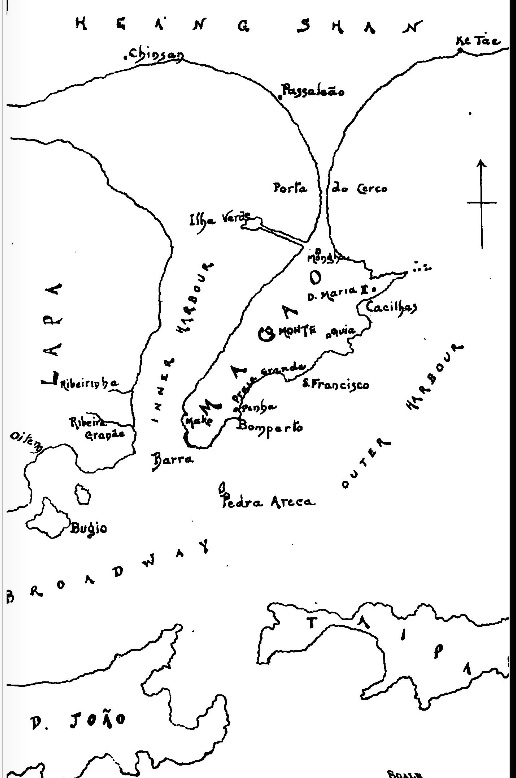
However, Montalto de Jesus, in bringing his book up-to-date, commented on the failure of the recent reclamation scheme. This was an attempt to provide Macau with a deep water port that would enable large ships to dock. The Porto Exterior, the Outer Harbour, where Hong Kong-Macau ferries have docked for many years now, was developed between 1922 and 1926, after a long period of planning. A large area earmarked for commercial development was reclaimed between Guia and the Fortaleza S. Francisco (St Francis’ Fort). Once guarding the northern end of the Praya Grande, the old wall that once protected the fort is now well inland. A deep water channel was dredged through the shallow water surrounding Macau, enabling large ships to dock. However, the Great Leap Forward did not happen. Macau remained trapped in what seemed to be permanent economic depression. There was little industry apart from the manufacture of fireworks, and none of the modern boom in tourism. ‘Even as many as fifty or a hundred a week would help swell business in the Colony’, noted Henrique Noronha sadly, writing to his second cousin Jack Braga on 25 September 1935.
Montalto de Jesus had an idea. Why not ask the League of Nations to take over? Founded in 1919 following World War I, the League was nominally responsible for the administration of most of the former German colonies in Africa and the Pacific. These were mandated to the victors – Britain, France and the United States. Australia administered the north-east portion of New Guinea. Besides these territories, the League directly administered an awkward hot spot: Danzig on the Baltic Sea. Danzig was dwarfed by its larger neighbours, Germany and Poland, both of whom wanted it; it could not survive with outside protection. Montalto de Jesus considered that Macau was in a similar position. Moreover in 1926, when he issued the book, the League appeared to be an effective champion of world peace and international justice.
Montalto de Jesus meant well. He thought he had proposed a way out of the deep pit into which Macau had sunk. However, he seemed to imply that Portugal was, like Germany, a failed colonial power. Moreover, Macau, like Danzig, could not survive on its own. Worse, it was a slap in the face to the Macau government which had invested a great deal of money and effort into a major project which was confidently expected to save Macau from obscurity and perhaps even collapse.
This unfortunate impression could not be ignored. Enraged, the Macau authorities withdrew the book from sale and seized all copies that had been sold. These would have been few, because the book was in English, then not widely spoken or read in Macau. The author was hauled before a court in Macau and fined $400 plus costs, or four months in gaol in default for breach of the press laws, apparently for sedition. Nearly three years later, when he sought to have the copies returned to him, his request was refused, and he retorted sarcastically that they might as well be burned. He was aghast when the authorities responded to this ill-judged defiance by doing just that. Later, he told a newspaper reporter that more than five hundred copies were burned in a public bonfire.
Jack Braga had little sympathy. On 17 March 1929, he commented in his diary,
In the evening I went to Monteiro’s for dinner, and the subject was Montalto, who is going about moaning about the burning of his books last Monday [i.e. 11 March], but as it was at his own request he has only himself to blame. What a fool he is. So full of vanity that he has wrecked his life rather than accept the advice of friends, from his very youth to the present day.
Nevertheless, Jack Braga, who taught English at St Joseph’s College, Macau, refused to surrender his copies. He may have had little sympathy with the situation Montalto had put himself in, but he disagreed profoundly with the authoritarian reaction of the Macau government, even keeping an envelope with some of the ashes. Courageously, he sent one of his copies to a bookbinder and had it bound in vellum – a beautiful white leather usually reserved for precious books. In this copy, he carefully added notes augmenting and referencing Montalto de Jesus’s work. He also contacted the author, seeking his comments and additional material for a possible third edition that might one day eventuate. These were also added in his neat, minuscule writing to this special copy. Wisely, Jack Braga added a note of warning: ‘These additions must be considered in the light of the bitterness felt by Montalto de Jesus after the suppression of the Second Edition of the book’. Montalto de Jesus had intended to make a constructive suggestion. Instead it had been seen as an affront. No greater insult to an author can be imagined that the public burning of his book, and Montalto de Jesus left Macau, swearing never to return. Hatred followed him. The Jornal de Macau reported on 28 November 1929 that Montalto, ‘esse inimigo dos Portugueses’– ‘this enemy of the Portuguese people’ – was in Shanghai. However, Hong Kong papers and the China Press supported this ‘aged, broken-hearted historian’, who died there three years later, on 19 May 1932.
That is not the end of the story. Many years later, in 1984, his book, whatever its faults, was reprinted by Oxford University Press as one of a series of important books on Far Eastern history. By then, the League of Nations had long since vanished and prosperity had at last come to Macau. Jack Braga’s beautifully bound copy of what had become the very rare 1926 edition, with its important manuscript additions, is still part of the J.M. Braga Collection in the National Library of Australia, which was described last year by the eminent librarian Dr. Andrew Gosling as ‘one of the gems of the National Library’. In having it bound in vellum, Jack Braga clearly saw this important and controversial book as one of the gems of his own collection. He may have condemned the author’s opinions and his folly in confronting the authorities, but he condemned more strongly the attempt to stamp them out by burning his book.
Stuart Braga, 11 October 2010
Notas:
1) It is in the National Library of Australia, BRA 2104. Another copy is at BRA 2754. In a very rare tribute to J.M. Braga, the library has kept his collection of books intact, and has given the books a distinctive ‘BRA’ number.
2) National Library of Australia, J.M. Braga Collection, MS4300, Series 5.2, Lectures, articles, notes – Macau, Folder 18.
3) Montalto de Jesus gave an extensive interview in Shanghai to the China Press, 23 June 1929.
4) J.M. Braga, Diary 1929, National Library of Australia, Braga Collection, MS 4300, series 1.
5) According to Dr Barney Koo, ‘Researching José Maria Braga’, a paper delivered in 2004 in Macau, p. 2.
6) It is in the National Library of Australia, MS 4369.
7) China Press, 23 June 1929.
8) North China Daily News, Shanghai, 29 May1932, quoted by Paul B. Spooner, PhD thesis, ‘Macau, The Port for Two Republics’, University of Hong Kong, 2009, pp. 1406, 1411. The place and date of Montalto’s death have only recently been established by Dr Spooner.
 Para este post seleccionei algumas imagens da primeira edição de "Historic Macao", a primeira história de Macau da autoria de Montalto de Jesus, publicada em 1902 em Hong Kong (Kelly & Walsh), e que iria fazer correr muita tinta...